Introduction to Robert McElvaine and His Current Major Project
Robert S. McElvaine's current project—by far the most ambitious and potentially meaningful of his career—is a dive into deep history with the objective of beginning to answer the most significant question in history, which has remained not just unanswered, but largely unasked, by the writers of the bestselling "Grand Narratives" of the human experience:
Why, when, and how did the belief that women are inferior to men arise and become accepted? That fiction has misshapen history and continues to plague us today? How could correcting that mistake and developing a new understanding based on the scientific truth as we now know it substantially improve the lives of all of us?
His early findings led to what has been termed the "McElvaine Thesis," presented in his 2001 book, Eve's Seed: Biology, the Sexes, and the Course of History. He is now expanding and deepening his argument in a new book project with the working title, An Agreed-Upon Fiction.
The bottom line in McElvaine's argument is that by rehumanizing women—that is, accepting what has always been fact, that they are completely equal human beings—we can begin to establish a genuinely human society in which people are not assigned a position of authority or subordination based on the categoy of human they are born or to which they has been assigned.
The McElvaine Thesis
The image above (drawn by ChatGPT at Robert McElvaine's direction) visually represents the underlying message of his argument: The age-old prison in which humanity has been incarcerated, an Imagined Order of "natural" dominance and subordination based on the fiction that women are innately inferior to men and its application to other categorical differences—class, race, ethnicity, religion, gender identity, and so forth—can be escaped by accepting the profound truth that woman and man, while not congruent, are completely equal. The shattered glass and torn apart barbed wire represent liberation from the constructed order. One of our main objectives, he says, should be to move beyond binary, either/or thinking. The horizontal pink-to-blue gradient represents a continuum rather than two mutually exclusive, vertically ranked categories. Instead of sex/gender and other categories being sealed realms with an impenetrable barrier dividing them, there is a spectrum. Difference remains, but where people are on it does not determine whether they are better or worse than others. Individuals are different. Categories are equal.
♦ ♦ ♦
The acceptance of the fiction that women are innately inferior to men became the template for categorical inequality between groupings of humans, providing the basis for the worldview that prevailed on much of the planet until it began to be challenged in the Enlightenment and American Revolution with the radical concept of innate human equality. It is to the paradigm of categorical inequality that authoritarians seek to return us in the Third Millennium.
An ancient misunderstanding of reproduction, which McElvaine names "Male Monocreationism," concluding that men are the creators (authors) of new life and so those with complete authority, was the font of this erroneous cosmology. Acceptance of the now undeniable truth that women and men are the co-authors of life and so have equal authority has the potential substantially to change the world for the better.
There is much more to it and over the quarter century since the publication of Eve's Seed, the author has been researching, traveling around the world, reading, thinking, and discussing with others this most important of all historical questions in order to refine, expand, and add to his conclusions.
The results will be presented in a major new book with the working title, An Agreed-Upon Fiction: How the Ancient Fiction of Women's Inferiority Shaped Human History—and How Exposing Its Origins Can Help Defeat Authoritarianism and Save Democracy.
Here is an interview McElvaine did explaining the earlier version of his argument.
https://robertsmcelvaine-2.com/mcelvaine-eves-seed-interview-video/
Brief Biographical Intro
Robert S. McElvaine is a historian, writer, commentator on cultural, historical, gender, and economic issues, amd world traveler. He has published eleven books and hundreds of pieces in the New York Times, Washington Post, Wall Street Journal, Newsweek, Politico, Salon, Lincoln Square, and many other major national venues. He is among the world's leading experts on the era of Great Depression. He is a liberal poliical actvist who has contributed to the speeches of three Democratic presidential nominees and to some of Bill Clinton's presidential speeches. He has been a guest on more than 100 television and radio programs and podcasts, including NBC's Today, ABC World News Tonight, NBC Nightly News, The Newshour on PBS, National Public Radio's All Things Considered and Morning Edition, Vox, Don Lemon on CNN, Alex Witt Reports on MS Now, Tucker Carlson Tonight on Fox, and BBC television and radio.
(Click on "Biography" at the top of the page for many more details.)
▼ ▼ ▼
McElvaine's Research & Writing Focus in the Twenty-first Century
Determining Why, When, and How
the Foundational Fiction of Human History—
"Woman Is Innately Inferior to Man"
—Arose, Became Doctrine, Imprisoned
Both Women and Men in an Imagined Order,
Misshaped History, and
Fuels Authoritarianism Today

For much of the past three decades, Dr. McElvaine has been exploring what he is convinced is the most important question in human history: Why, how, and when did the belief that women are innately inferior arise and come to be taken as a never-to-be-questioned truth? It is, he firmly belies, the most powerful force in misshaping history and remains the power behind the authoritari threat today.
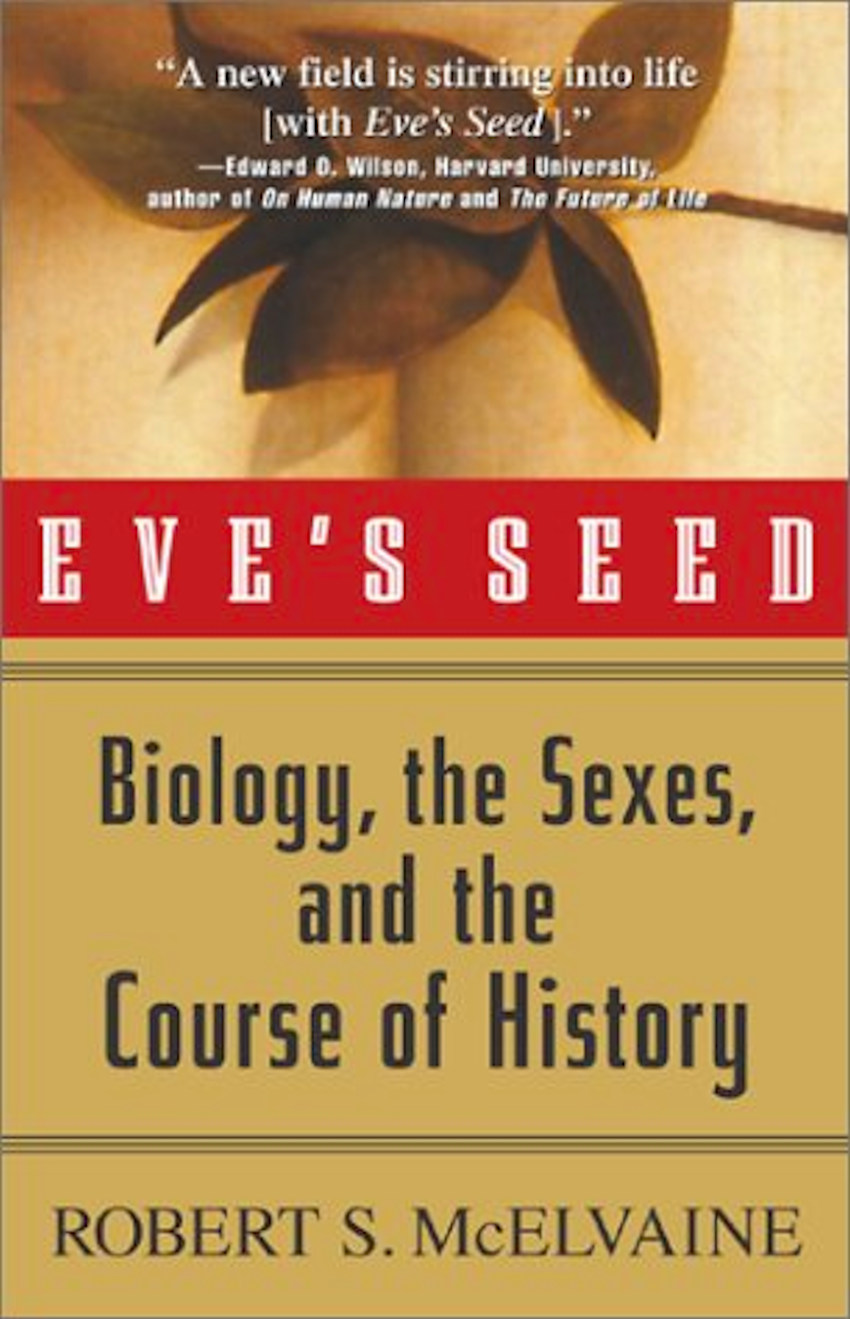
His first book addressing this question, Eve's Seed: Biology, the Sexes, and the Course of History (2001), was effusively praised by leading historians, anthropologists, biologists, linguists, writers, and feminists. He has spoken on his work on this subject at major academic confrences in the United States, Russia, Austria, Australia, New Zealand, Korea, South Africa, Papua New Guinea, and India on his ideas about the central influence on human history of various misconceptions and metaphors about the sexes. Eve's Seed received glowing comments from both general readers and academics, including a starred review in Publishers Weekly ("a radical rethinking of the basic 'truths' on which cultures have been constructed"). His thesis was the topic of one of the lead sessions at the annual meeting of the American Historical Association in Boston in 2001 and atthe American Anthropolical Association, as well as academic conferences in biology, language, politics, and Psychology. His ideas were also featured in an article in the Arts & Ideas section of the New York Times. A Chinese edition of the book was published in 2004.The Los Angeles Times Book Review named Eve's Seed one of the "Best Books of 2001" and called it "a bestseller waiting to be discovered."
A quarter century later, that book is still waiting to be discovered. It never broke through significantly into the public square.There are many possible reasons for that circumstance, but what is perhaps the most important one reflects what that book and the new one explore. "I have learned that there will always be people who say it's not the right time to talk about gender equality," Melinda French Gates wrote in the New York Times in 2024. That has been the case for millennia becuase gender inequality has been the foundation of the way societies have been organized on the basis of the assumption of inherent ineqaulity of categories of humans, which are modeled on the belief that woman is inferior to man.
The public in 2001 was not yet ready for the full-frontal challenge McElvaine makes in showing that the purported "basic truths" on which cultures are constructed are based on a long agreed-upon fiction. Maintaining that fiction is central to the project of authoritarians today. Putting women and all other categories of humans who have been classified as "=Women" back "in their place" is incompatible with democracy.
The current authoritrarian headlong rush to destroy all the gains made since the 1960s towards across-the-board equal standing—what McElvaine terms "Birthright Humanity"—made by women, people of color, LGBTQ people, and other categories that had been placed in the lower, =woman, position in the vertical binaries modeled on the purported male > female inequality makes clear that the time to talk about gender equality in a serious, deeply researched, engaging, and persusive way has arrived.
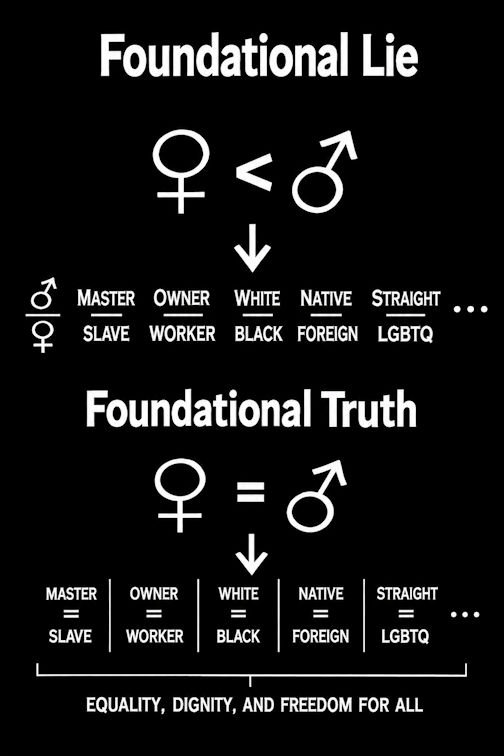
Humans have for thousands of years been imprisoned in an Imagined Order based on the fiction that women are inherently inferior to men, which became the template for other putative vertical binaries of dominance and subordination: categorical inequality—some kinds of humans are innately better than others. Master > slave, Aristocrat > commoner, White > nonwhite, Owner > worker, Straight > LGBTQ and so on were plugged into the Foundational Lie, ♂ >♀ and those classified in the bottom of each came to be seen as and treated as =women. The top and bottom categories are separated by a thick but transparent barrier: a glass floor/ceiling through which they can see the other group. Today's authoritarian cry, "Build the Wall!" really means "Rebuild the floor/ceilings!"
The book will directly address the central question that most of the "grand narratives" of the human experience that have become bestsellers in recent decades do not even ask:
When, how, and why did human beings come to believe that inequality between categories of people was natural in the first place?